For decades, security cameras were like introverts at a noisy party quietly watching, saying nothing. They saw everything but never spoke.
That’s changing fast. Cameras are getting ears. And not the cheap kind you bolt on as a microphone. We’re talking about real understanding — of human speech, tone, and context.
Welcome to SmartVision Software, where Automatic Speech Recognition (ASR) turns video surveillance into something a little more... conversational.
From “Big Brother” to “Smart Listener”
Traditional surveillance focuses on pixels: faces, license plates, suspicious objects. But here’s the thing — context lives in sound.
People shout, whisper, argue, plead, or command. That’s where the story unfolds.
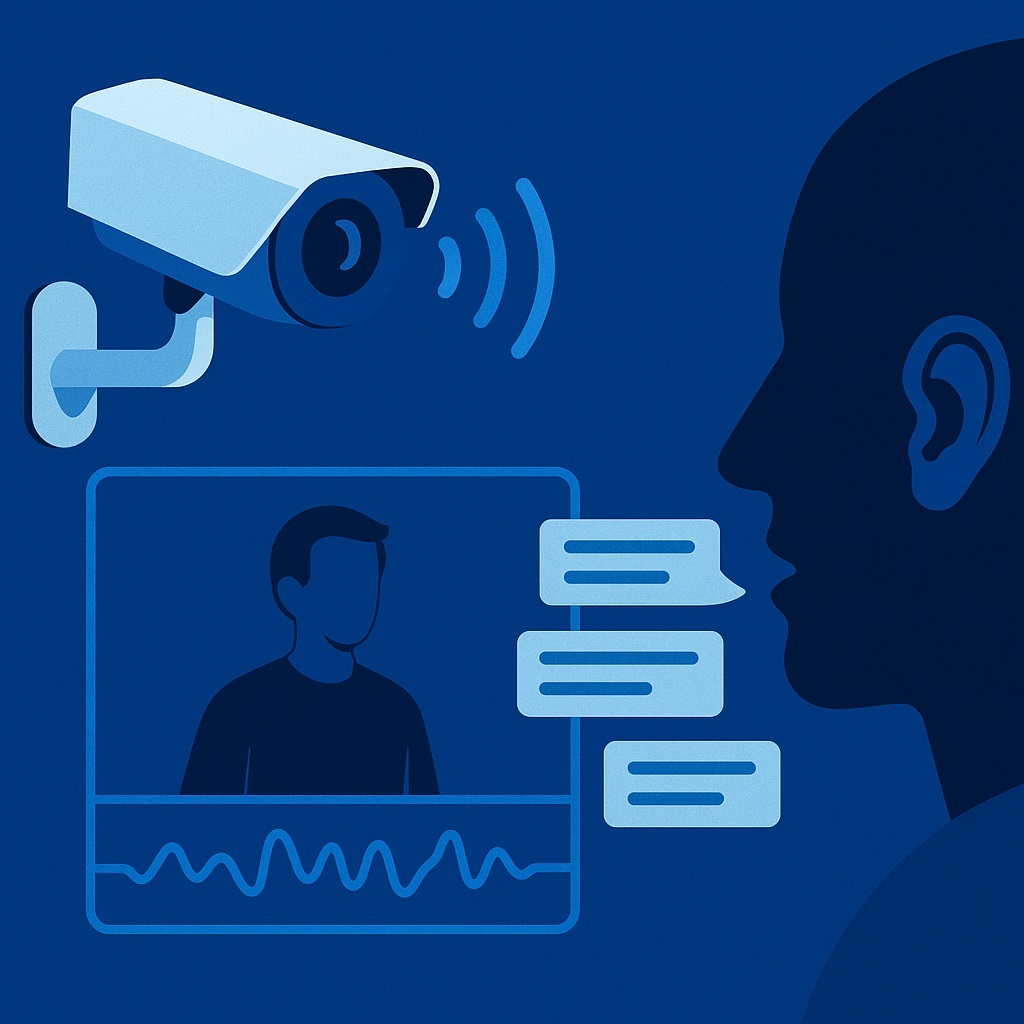
SmartVision’s real-time ASR doesn’t just record noise. It listens, transcribes, analyzes, and ties what it hears to what it sees - fusing audio and video into one intelligent stream. Suddenly, your security feed isn’t just silent footage; it’s a searchable, timestamped transcript of real life.
And yes, you can now literally search your archive by typing:
“Fire,” “Leave the bag,” or “Cancel order.”
Seconds later, Ai Software jumps to the right moment. No more scrubbing through 48 hours of silence.
When Video Gets a Voice
ASR works in multiple modes - from full AV recording to “privacy-first” silent transcription. Here’s the lineup:
🎥 1. With Video Recording
The classic setup: SmartVision records audio + video, creating a perfectly synced text track.
Use cases:
- Keyword Search: “Complaint,” “refund,” “fire,” “don’t touch that!”
- Incident Reports: Show who said what — to the second.
- Service Monitoring: Gauge politeness levels or catch heated moments.
- Multilingual Sites: Automatic translation on the fly — “Excuse me, where’s the exit?” → “Извините, где выход?”
- Training: Build libraries of real dialogues for staff education.
🤫 2. Without Audio Storage (Privacy Mode)
Sometimes laws (or lawyers) say no audio recording. Hospitals, banks, private offices — we get it.
In this mode, ai software stores only text metadata: recognized words, time, and confidence score.
If someone shouts “Help!” or “Gun!”, it triggers an alert — without saving the raw sound.
Result: a privacy-friendly system that still hears what matters.
🎧 3. Audio-Only Monitoring
Not every sensor needs a lens. VMS Software also works with intercoms, SIP phones, and radios.
It listens for intent: “Delivery,” “Visitor,” “Threat.”
For guards, it’s a dream: a short text summary before they even pick up the mic.
And when reviewing logs, managers can simply search for “post 3, alarm” instead of replaying static-filled chatter.
🔊 4. When Sound Isn’t Speech
Speech is great. But what about glass breaking? A scream? A gunshot?
VMS detects audio patterns — and reacts.
- “Scream” → PTZ camera auto-zooms.
- “Glass” → spotlight on.
- “Gunshot” → alert, record, flag as possible assault.
Everything happens locally, on the edge, without sending data to the cloud.
Fast. Secure. No creepy eavesdropping.
The Art of Hearing Without Spying
We all love security — until it feels like surveillance.
Ai Software walks that fine line with surgical precision:
- Record only on events or alarms.
- Delete audio after processing.
- Keep transcripts, not voices.
- Stay compliant with privacy regulations worldwide.
Think of it as “awareness without overreach.”
Real-Life Use Cases
🏭 Industrial sites: Detects “Stop the line!” or “Injury!” — halts machinery automatically.
🏢 Offices & lobbies: Spots key phrases like “complaint” or “cancel,” improving service analytics.
🚇 Public areas: “Help!”, “Fire!”, “Police!” → triggers instant emergency protocols.
🏘️ Residential complexes: Transcribes intercoms “door stuck,” “noise at night” — searchable by topic.
✈️ Airports & transport: Recognizes multiple languages on the fly for global passengers.
🏥 Hospitals & schools: Alerts staff when someone says “hurt,” “fall,” or “emergency.”
Multilingual, Multiserver, Multitalented
For example, SmartVision runs on a multi-server architecture with edge, local, and cloud ASR options.
Audio can be processed on the camera itself, on a local GPU cluster, or in a scalable cloud engine depending on your policy and bandwidth.
And because the system supports dozens of languages: English, Spanish, Chinese, Arabic, Russian, and more it can even switch between them automatically.
In one control room, an operator reads “Fire alarm.”
In another, across the world, the same event appears as “Пожарная тревога.”
That’s global security, synchronized.
Why Should a Camera Understand Speech?
Because seeing isn’t enough anymore.
A video feed can show what happened - but not why.
When a system hears and understands, it adds context.
A simple phrase “Leave it by the door” becomes part of a searchable event log linked to motion and face data.
Smart Vision doesn’t just observe behavior - it interprets it.
It’s less “Big Brother,” more “Big Listener.”
The Future Sounds Smart
AI is sneaking into everything — thermostats, coffee machines, toothbrushes.
But in surveillance, it’s not a gimmick. It’s the bridge between sight and understanding.
Ai Software gives cameras something they’ve never had before: a sense of hearing.
It turns silent archives into living, searchable stories — and makes your security system a little more human.