Warehouse safety has always been one of the top priorities for owners, managers, and shift supervisors. This is not only about meeting occupational safety requirements, but also about protecting employees, preserving goods, maintaining stable operations, and reducing losses. A well-designed safety system helps prevent injuries and also makes warehouse work more organized and predictable.
Warehouse operations involve constant work in a high-risk environment. Forklifts, carts, conveyors, racks, loading and unloading zones, heavy goods, and sometimes chemicals or other hazardous materials are all part of daily activity. The larger the warehouse and the faster the pace of operations, the higher the risk of errors, collisions, falls, injuries, and other incidents.
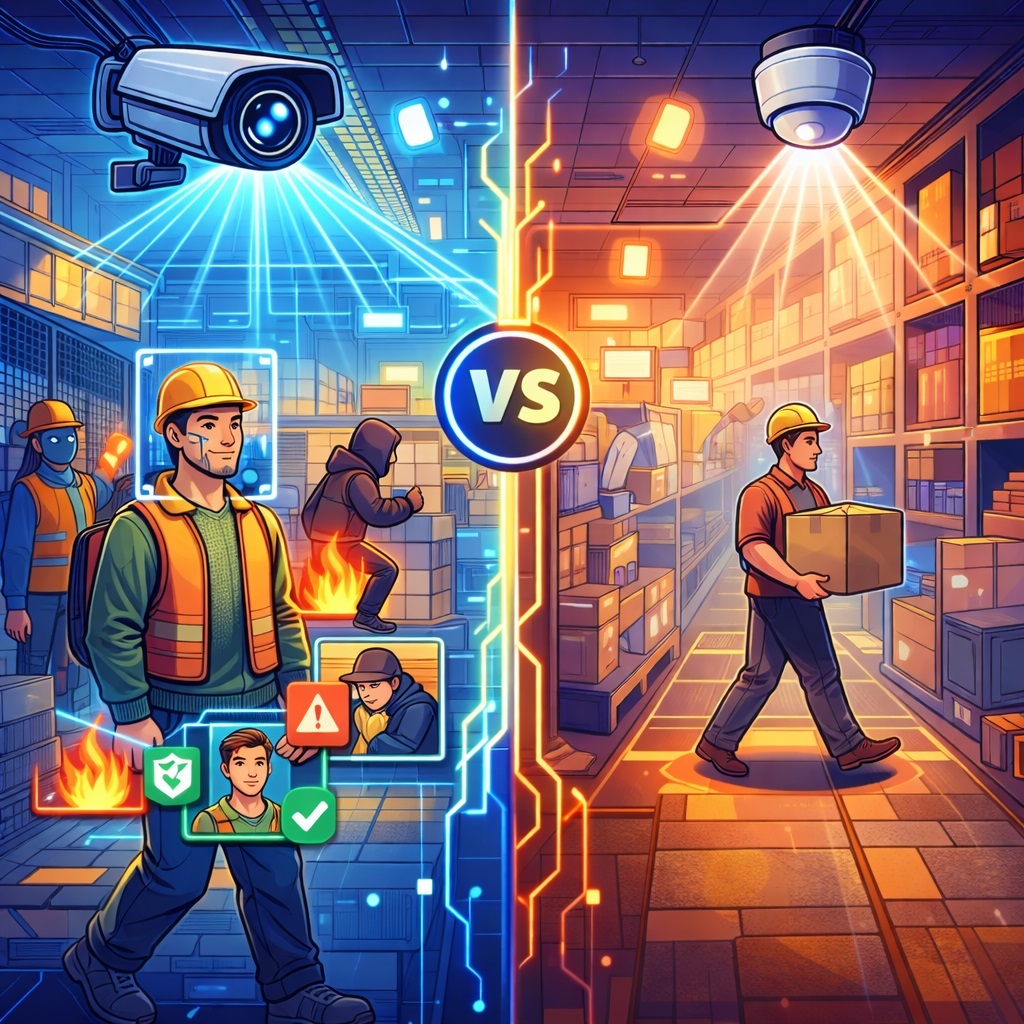
Against this backdrop, the market активно promotes AI-powered cameras as a universal answer to almost every problem. They can recognize people, vehicles, missing hard hats, and other violations. At the same time, ordinary motion, door, smoke, temperature, and gas sensors remain extremely useful in practice. They are simpler, less expensive, and in many situations more than sufficient.
So the main question today is not: which is better, AI cameras or simple sensors? The better question is: in which situations is advanced video analytics truly necessary, and where is it more reasonable to rely on proven, straightforward tools?
Why warehouse safety requires special attention
A warehouse is not an office, where the main threats are spilled coffee and a forgotten password. In a warehouse, the risks are far more physical, and therefore much more dangerous.
The main hazards include:
- handling heavy goods;
- operating forklifts and other warehouse vehicles;
- improper storage of goods;
- blocked aisles;
- slippery floors;
- dangerous loading dock areas;
- working with chemical or flammable substances;
- lack of protective equipment or incorrect use of it;
- insufficient staff training;
- poor emergency preparedness.
That is why warehouse safety cannot be reduced to video surveillance alone or to staff instruction alone. It is always a combination of organizational measures, rules, training, and technical tools.
What should form the foundation of warehouse safety
Before discussing cameras, sensors, and automation, it is important to remember one simple thing: no technology can replace order and discipline in operations. If a warehouse does not have clear rules, floor markings, access control, and regular inspections, no modern analytics system will save it.
The foundation of safe warehouse operations includes:
- an emergency or fire response plan;
- employee training in safe work practices;
- control over who is authorized to use equipment and machinery;
- first-aid kits and emergency medical supplies;
- working and accessible emergency exits;
- clearly marked hazardous areas;
- regular checks of floors, racks, gates, and loading zones;
- proper protective gear for employees;
- regular inspections and internal audits.
Only after that does it make sense to decide which technical solutions are truly useful and which ones are just expensive decoration for a report.
When ordinary sensors are more cost-effective
Simple sensors have one important advantage: they solve a specific problem without unnecessary complexity. They do not try to interpret the entire scene, they do not depend on camera angle, and they are often faster and more reliable when the goal is to detect one clearly defined event.
Ordinary sensors are especially cost-effective in the following situations.
When you need to detect a simple, unambiguous fact
If the task can be stated very simply, then the solution should usually be simple as well.
For example, you may need to know:
- whether there is motion in a room;
- whether a door is open or closed;
- whether smoke is present;
- whether the temperature has exceeded a limit;
- whether a gate has been opened;
- whether there is a water or gas leak.
In such cases, installing a camera with video analytics is often excessive. It is like using a tractor to move a single shovel.
When low deployment cost matters
If you need to equip many small rooms, gates, service corridors, electrical rooms, cold storage areas, or technical zones, sensors usually win for several reasons:
- they are cheaper;
- they are easier to install;
- they do not require powerful computing hardware;
- they are not dependent on lighting quality;
- they do not need complex configuration;
- they are easier to test and maintain.
For many warehouses, this becomes the deciding factor.
When you need very clear logic
With a sensor, the logic is obvious: if it triggered, then a specific event occurred. A door opened, smoke appeared, the temperature rose, or motion was detected.
This simplicity is especially useful in tasks related to:
- fire safety;
- protection of engineering and utility rooms;
- control of gates and emergency exits;
- monitoring refrigerated and freezer zones;
- raising an alarm without needing to analyze video.
When video confirmation is not required
Not every event needs to be reviewed on video. In some cases, the signal itself is enough to trigger the appropriate response:
- activate an audible warning;
- send a notification to the duty officer;
- switch on lights;
- block access;
- forward an alarm to security;
- record the event in a log.
In these cases, sensors are fully justified and provide strong results at minimal cost.
When AI cameras are genuinely more useful
Now to the other side of the question. There are tasks where a simple sensor is too crude a tool. It may tell you that something happened, but it cannot explain what exactly happened, who was involved, or how dangerous the situation is.
This is where cameras with intelligent image analysis start delivering real value.
When you need to distinguish between people, vehicles, and other objects
A normal motion sensor cannot tell the difference between a person, a forklift, a box, a shadow, or a moving gate. A camera with image analysis can distinguish object types and filter out some false alarms.
This is useful in places such as:
- forklift traffic zones;
- warehouse intersections;
- aisles between racks;
- loading dock areas;
- outdoor zones and perimeter areas.
If it is important not just to detect movement but to understand who or what is in the area, a camera offers a clear advantage.
When personal protective equipment compliance must be monitored
A standard sensor cannot determine whether an employee entered a hazardous area without a hard hat, high-visibility vest, or other required protective gear. That requires video and image analysis.
This kind of monitoring is especially useful:
- in areas where machinery is operating;
- in high-risk zones;
- in loading and unloading areas;
- in production-storage environments;
- at facilities with strict occupational safety requirements.
When dangerous interaction between people and machinery must be tracked
Many serious warehouse incidents do not happen simply because something moved, but because a person and a machine came dangerously close to one another. A worker may unexpectedly step into a forklift path or enter a restricted area.
In such cases, a camera can help detect:
- a person entering a hazardous area;
- crossing of a virtual line;
- prolonged presence in a restricted zone;
- crowding;
- a person appearing near moving machinery.
These are tasks that are difficult to solve reliably with a single sensor.
When incidents need to be reviewed afterward
One of the main advantages of a camera is that it provides not just an alarm, but also a visual record of what happened. After an alert, you can determine:
- what exactly occurred;
- who was in the area;
- how the situation developed;
- whether safety rules were violated;
- whether the alert was justified.
This is important for:
- internal incident review;
- staff training;
- checking disputed situations;
- identifying near-miss events that did not cause injury but could have;
- improving warehouse organization.
When the warehouse is large and complex
In a small warehouse, a shift supervisor often knows the weak points without any advanced technology. But in a large facility with heavy flows of people, goods, and vehicles, manual oversight quickly becomes insufficient.
In large warehouses, cameras are especially useful where it is necessary to:
- monitor multiple risk zones at once;
- identify dangerous situations faster;
- verify alarms without going to the scene;
- maintain an overall view of the site;
- detect repeated violations.
Where AI cameras are most often overestimated
Despite all their advantages, there is a great deal of exaggeration surrounding intelligent cameras today. Sometimes they are applied where they bring little real benefit.
This usually happens in the following situations:
- when the task is to control a very simple event that a sensor already detects reliably;
- when the site has poor lighting, dust, backlight, or an unsuitable camera angle;
- when there is no staff to review alerts and maintain the system;
- when management expects technology to replace training and discipline;
- when cameras are installed everywhere simply because it is fashionable.
It is important to remember that a camera does not replace warehouse traffic rules, floor markings, guardrails, mirrors, employee training, or equipment checks. It can help, but it cannot replace the organization of safety.
Where ordinary sensors are underestimated
There is also an opposite mistake. Sometimes simple sensors are viewed as too primitive. In reality, they remain a very useful and practical tool.
They are especially worth using for tasks such as:
- monitoring doors, gates, and hatches;
- detecting smoke, gas, and overheating;
- climate monitoring;
- protecting technical rooms;
- sending signals to automation systems;
- monitoring specific hazardous openings and passageways;
- detecting presence in enclosed areas;
- triggering alerts and alarms.
In many of these scenarios, a sensor is the most reasonable choice: inexpensive, reliable, and easy to understand.
The best warehouse approach: combining technologies
In practice, the most reasonable path is not to choose only one type of tool. The best results usually come from combining technologies, with each one handling the task it is best suited for.
Ordinary sensors are better where you need to:
- detect a specific event quickly and reliably;
- trigger automation;
- monitor environmental conditions;
- protect service and engineering areas;
- receive a clear signal without complex analysis.
AI cameras are better where you need to:
- distinguish between people, vehicles, and other objects;
- monitor hazardous areas;
- detect violations of worker protection requirements;
- obtain visual evidence for incident review;
- monitor behavior rather than just the fact of movement.
An especially strong effect comes from using them together. For example:
- a gate sensor sends a signal, and a camera immediately shows the operator what is happening in that area;
- a smoke detector triggers an alarm, and video surveillance helps assess the scale of the situation;
- a camera detects a person in a hazardous zone, and the system automatically activates an audible warning;
- a temperature sensor reports a deviation, and the operator checks the situation visually.
This is what a mature, practical approach looks like. No unnecessary obsession with trends, and no attempt to save money where saving becomes dangerous.
How to decide what to choose for a specific warehouse
Before deployment, it is useful to answer a few simple questions.
If the answer you need is just “yes” or “no”
Sensors are usually enough.
Examples:
- is the door open or closed;
- is there smoke or not;
- has the temperature exceeded the limit or not;
- is there motion in the room or not.
If you need to understand what exactly is happening
A camera is more likely to be required.
Examples:
- who entered the hazardous area;
- is it a person or a forklift;
- was the employee without a hard hat;
- did dangerous proximity occur between people and machinery;
- what caused the alert.
If the budget is limited
It is more reasonable to start with the basics:
- order and discipline;
- staff training;
- floor markings;
- standard video surveillance;
- sensors in critical areas.
If the cost of an error is very high
It makes sense to strengthen the site selectively with intelligent cameras, especially in places such as:
- machinery traffic zones;
- intensive loading and unloading areas;
- high-risk zones;
- places with frequent violations;
- areas with complex logistics.
A practical deployment sequence without chasing trends
For most warehouses, a sensible implementation sequence looks like this:
- First, establish order in the core processes:
- staff training;
- traffic routes;
- rules for working with machinery;
- hazardous area markings;
- checks of racks, gates, floors, and lighting.
- Then address the basic risks with simple tools:
- smoke detectors;
- temperature sensors;
- door and gate sensors;
- motion sensors in service and technical rooms;
- alert systems.
- After that, deploy cameras selectively where they truly provide an advantage:
- in forklift traffic zones;
- at intersections;
- in loading and unloading areas;
- in hazardous production-related zones;
- where protective equipment compliance and incident review are important.
This approach is usually far more useful than trying to cover an entire warehouse immediately with expensive intelligent cameras and then being surprised by the bills and the number of false alarms.
A short checklist before choosing equipment
Before buying equipment, it is worth reviewing the following:
- What specific risk do we want to reduce?
- Do we need to distinguish object types, or is the fact of the event enough?
- Is video confirmation required?
- Do we need to review incidents afterward?
- How important are low cost and ease of maintenance?
- Does the facility have suitable conditions for cameras to work well?
- Who will monitor alerts and maintain the system?
- Can the task be solved more simply without losing effectiveness?
If in most cases you just need a reliable signal, sensors will usually be enough.
If you need to understand the situation, see violations, and analyze dangerous events, then cameras with intelligent image analysis are justified.
Warehouse safety does not respond well to extremes. It works poorly both with blind faith in fashionable technology and with the desire to solve every problem in the cheapest possible way. Ordinary sensors remain an excellent choice for simple, large-scale, and clearly defined scenarios. They are reliable, understandable, and economical. AI cameras are genuinely useful where context, object differentiation, hazardous-area monitoring, and incident review matter.
So in practice, the best question is this: where does the warehouse truly need intelligent video analytics, and where is a standard sensor with a properly configured alert enough? That is the approach that creates a sensible, stable, and genuinely useful warehouse safety system.