
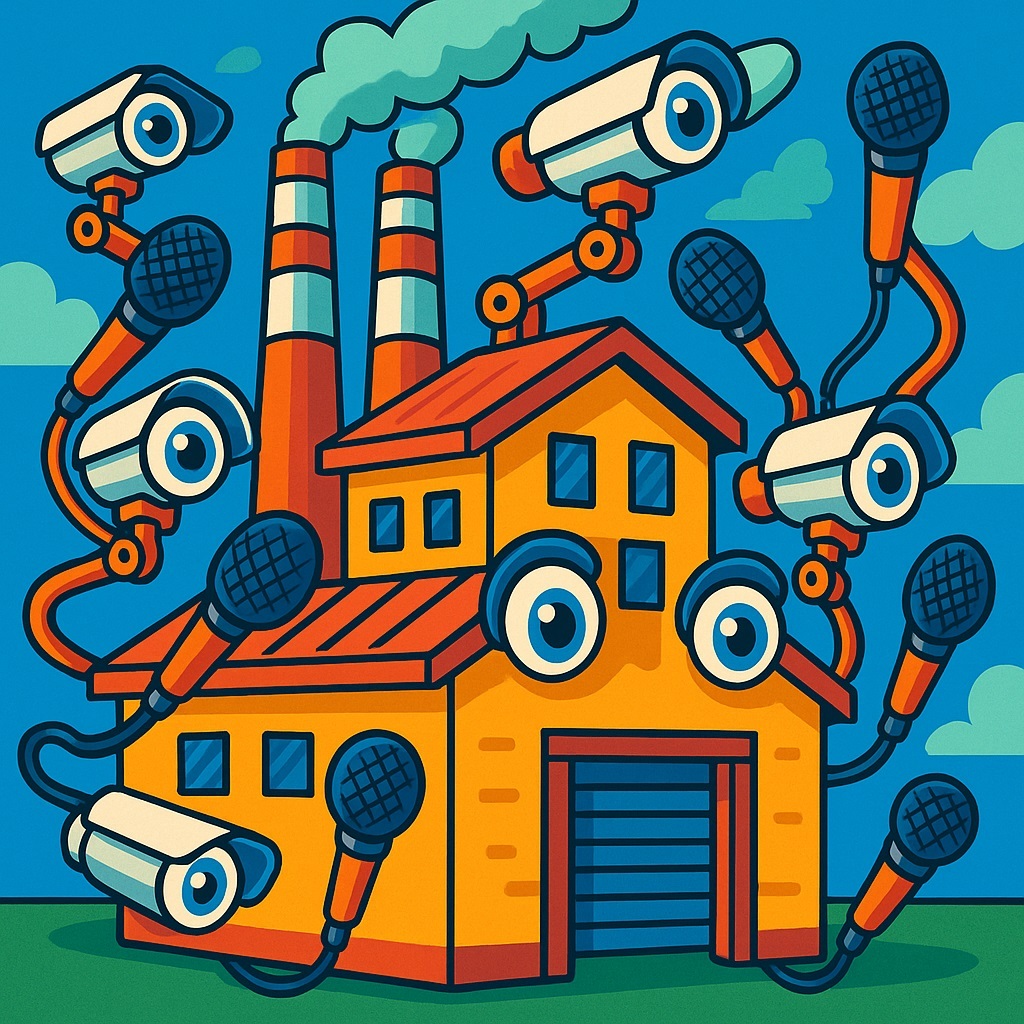
Industrial Video Surveillance: Your Factory Is Watching You (And Honestly, It’s About Time)
Factories have always been loud, grimy, and full of machines that look like they’d unionize if they ever gained sentience. And now, thanks to cameras and AI, they sort of have. Industrial sites are finally waking up to the fact that “automation” isn’t about fancy robotics or shiny dashboards — it’s about knowing what the hell is going on in real time instead of relying on paperwork written by someone who definitely filled it out five minutes before their shift ended.
Let’s be honest: for decades, manufacturing data has been a polite fiction. Reports would claim “all systems normal” even when half the line sounded like it was reenacting a minor earthquake. Sensors existed mostly to blink reassuringly. Cameras stared into the void, recording footage no one ever watched unless something had already exploded.
Now AI shows up, wearing metaphorical sunglasses indoors, asking the obvious question:
“Okay, but do you actually have data? Real data? Not the imaginary kind?”
And that’s where the industrial world is getting its collective wake-up call.
Before you can inject intelligence into a factory, you need observation — the industrial equivalent of admitting you have a problem. Most factories already have cameras; they’re just spectacularly underachieving. Add video analytics, and suddenly these cameras go from decorative wall furniture to the factory’s sensory cortex.
A model can spot missing helmets, unsafe wandering, temperature spikes, micro-cracks, and the moment a conveyor belt decides it’s had enough of this job. It doesn’t blink, doesn’t nap, and doesn’t take smoke breaks. It simply looks — relentlessly — and reports what it sees.
And workers? Well, they learn quickly that AI isn’t judging them. It just wants everyone to stop doing questionable things near heavy machinery.
Quality control might be the area where AI has the most fun. Imagine a hyper-focused inspector who examines every product with the intensity of someone trying to find flaws in their ex’s new partner. The camera becomes that inspector. It checks everything: packaging seams, label placement, tiny scratches, dodgy colors, weak solder joints. It’s relentless.
The uncomfortable truth: factories often discover defects they never knew they were producing — because humans simply can’t stare at thousands of identical items without eventually glazing over. AI doesn’t glaze. It doesn’t even blink.
Predictive maintenance is where AI really flexes. Traditional maintenance works like a dentist appointment: “Come back in six months unless something falls off.” AI, however, listens to machines the way a car nerd listens to engines in a parking lot.
It picks up patterns in vibration, current, temperature — the symptoms of failure long before failure shows up. Bearings whisper. Pumps wheeze. Motors vibrate with the emotional instability of a stressed-out grad student. AI notices all of it and gently taps you on the shoulder with:
“You might want to fix this before it goes full catastrophic.”
The cost savings are real, measurable, and deliciously satisfying.
Energy efficiency is another industrial embarrassment AI fixes quietly. Most factories use energy like teenagers use Wi-Fi — constantly, indiscriminately, and with total disregard for consequences. Compressors run at night like they’re training for a marathon. HVAC systems duel to the death. Nobody knows why.
AI looks at the power patterns and calmly identifies the culprits: machines running empty, cooling running overtime, heating fighting cooling, and all that beautiful, pointless waste. With a few schedule tweaks, factories suddenly discover they didn’t need to burn half a power plant’s output after all.
But here’s the real kicker: small factories — the scrappy ones — get the biggest boost. Two cameras and a cheap sensor can reveal more about production bottlenecks than a thousand consultant slides. Downtime, missteps, scrap — it all becomes visible. And once you can see your problems, fixing them becomes the easy part.
The trick, of course, is integration. Right now, most factories resemble digital patchwork quilts: video here, SCADA there, spreadsheets scattered like fallen leaves, and at least one old PC running Windows XP holding an essential workflow hostage. AI thrives only when everything talks to everything else. A conveyor stopping should ripple directly into scheduling, logistics, and delivery timelines — not require four phone calls and two frantic emails.
The future factory won’t be “smart.” It’ll be self-aware enough to handle scheduling, maintenance, safety, and energy without begging humans for attention. But that future starts with the basics: cameras, sensors, and the humility to admit your factory has been flying blind for years.
Once you give your plant the ability to watch, it learns to think. And once it learns to think, it learns to improve. The moment that happens, you’re no longer “implementing AI.” Your factory is simply — finally — paying attention.