Parking Lots: The Ultimate Exam for Video Surveillance
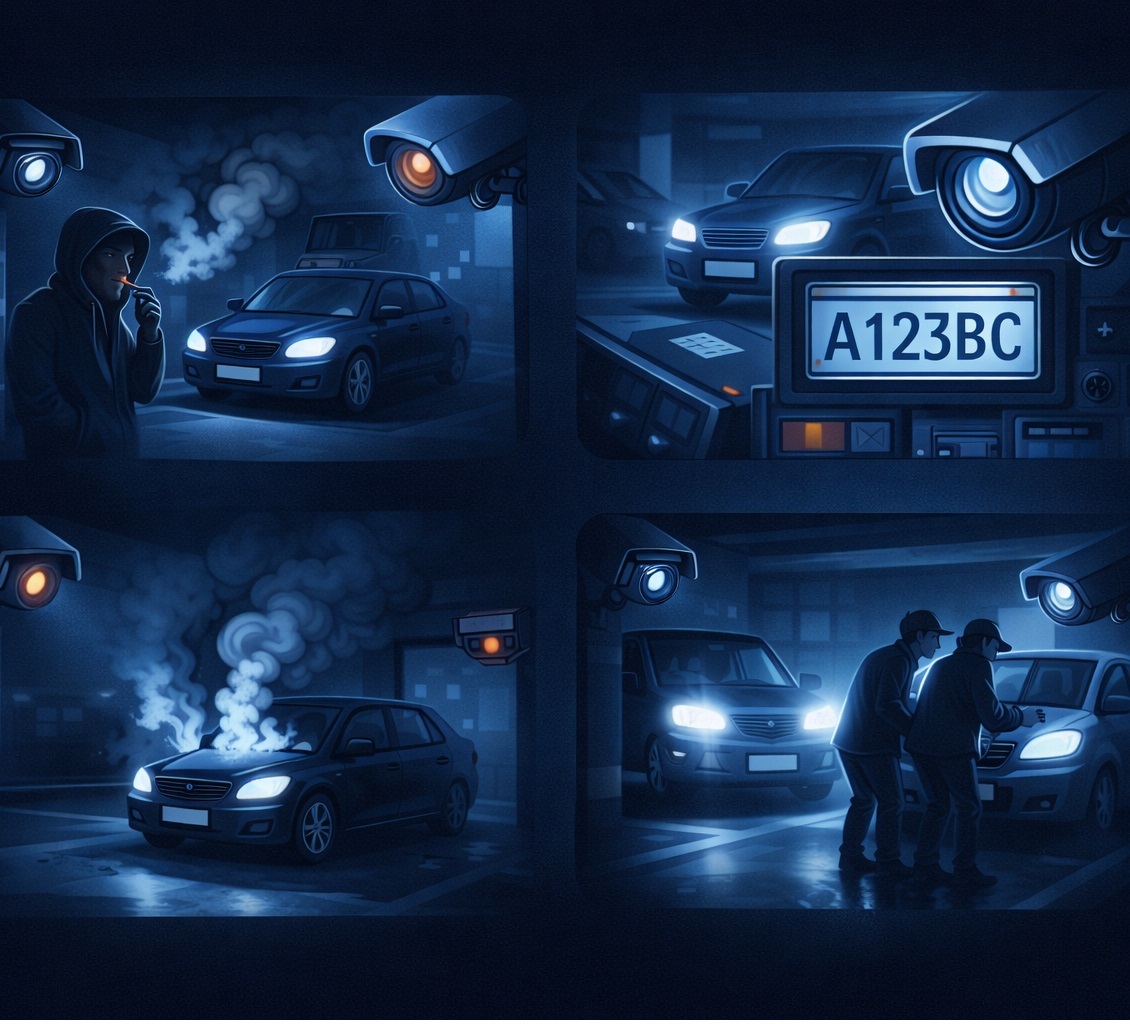
If you really want to test any video surveillance system honestly, don’t send it to a retail floor, an office, or a server room. Send it to a parking lot. Preferably an underground one—with low ceilings, reflective concrete, headlights, smokers, and the eternal question: “Is he just standing there, or is he already up to something?”
A parking lot is where video surveillance either becomes intelligent—or finally admits it’s just decorative.
Everything here is bad for algorithms: complex lighting, chaotic movement, and no clear “normal / abnormal” scenarios.
At the same time, everything is perfect for criminals, smokers, and people who leave a car running “just for a minute” - which somehow turns into forty.
That’s why parking automation today is not a trendy buzzword, but a harsh necessity. Cameras can no longer just record. They have to understand, analyze, and intervene in time.
Object Detection: When “Something Is Moving” Is No Longer an Argument
Let’s start with the basics. Object detection is the foundation of modern video surveillance. Without it, everything else turns into theater of the absurd.
The old-school philosophy was simple:
- motion → alarm
- no motion → calm
Parking lots quickly explained why this doesn’t work.
On a parking lot, everything moves:
- cars,
- people,
- shadows,
- headlights,
- reflections,
- cigarette smoke,
- steam in winter.
Modern object detection doesn’t start with pixels—it starts with categories:
person, vehicle, group of people, stationary car, moving car, bicycle, scooter—all with contextual awareness.
For a shopping mall, it matters to distinguish:
- a customer walking to their car,
- a person circling around for ten minutes,
- a car that pulled in and left,
- a car that’s standing there, but clearly not “just standing.”
For office parking, it’s simpler and stricter: at night, a person is already an event.
A car without authorization is a reason to react.
For residential complexes, it’s the hardest case of all: here, “normal” looks like chaos, and the algorithm must be as patient as a concierge with twenty years of experience.
License Plate Recognition: When a Car Stops Being Anonymous
License Plate Recognition (LPR) is the moment when a parking lot suddenly loses its sense of impunity.
Before LPR, a car was just a car.
Now it’s an identifiable object with a behavioral history.
In practice, this gives far more than it seems:
- identifying vehicles that appear regularly without a clear reason;
- recording repeated incidents;
- access control without barriers or cards;
- traffic flow and dwell-time analysis.
For shopping centers, plates help identify “regular guests” who are not there to shop.
For offices, they automatically filter out those who “just got the address wrong.”
For residential complexes, they bring order without turning security into an interrogation unit.
Importantly, modern plate recognition isn’t just “reading characters.” It also handles angles, dirt, reflections, different formats—and parking’s favorite pastime: headlights shining straight into the camera.
Smoking in Prohibited Areas: A Small Cigarette, Big Problems
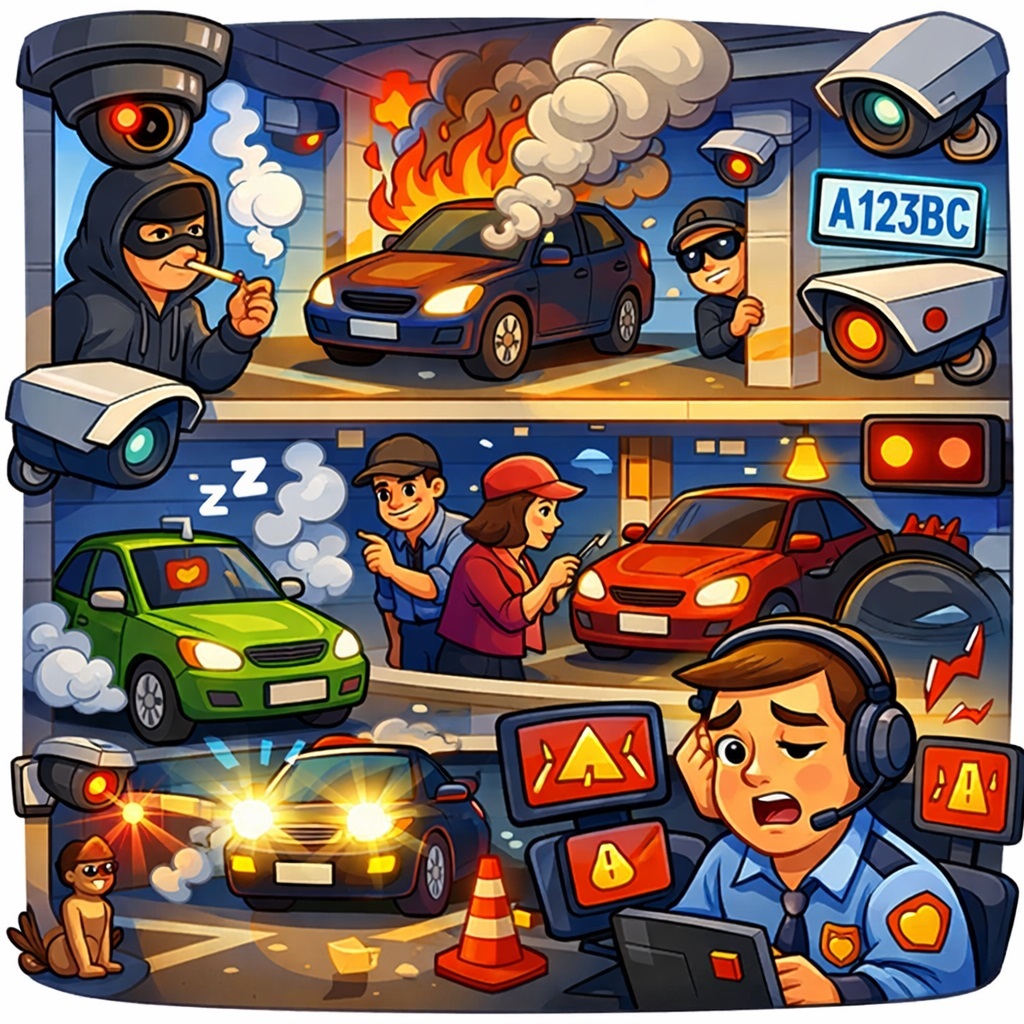
The smoker in a parking lot is an underestimated character.
He’s not really a criminal.
He’s just “for a minute.”
Yet big problems often start with him.
Underground parking, malls, office buildings, and residential complexes increasingly ban smoking not for aesthetics, but for real risks:
- ventilation systems,
- flammable materials,
- cars with fuel leaks,
- and the classic cigarette butt tossed “somewhere.”
From a video analytics perspective, smoking is one of the hardest tasks. Why?
Because:
- there is smoke,
- there is almost no fire,
- movement is brief,
- and false alarms must be avoided at all costs.
Modern systems learn to distinguish:
- local, quickly dissipating cigarette smoke,
- lack of fire development,
- human behavior (gestures, hand position, pauses).
This is where video surveillance stops being “eyes” and becomes behavioral analysis.
Not just “smoke = alarm,” but: smoke + person + characteristic dynamics = smoking.
Yes, it’s difficult. Yes, it doesn’t work without context. But these are exactly the tasks that separate real automation from imitation.
Smoke and Fire: How Not to Confuse a Fire with Everyday Life
Smoke and fire detection in parking lots is a favorite source of conflict between engineers, security teams, and reality itself.
The problem is simple: a parking lot is the perfect place for everything that looks like smoke or fire:
- exhaust fumes,
- steam,
- reflections,
- welding work,
- sunlight glare,
- headlights in fog.
Primitive algorithms react to everything.
Smart ones analyze how the event develops over time.
A real fire:
- increases in intensity,
- spreads,
- changes the structure of the scene,
- doesn’t disappear after three seconds.
A cigarette:
- is local,
- short-lived,
- doesn’t form a stable source,
- and is usually accompanied by very specific human behavior.
Modern video analytics doesn’t look at “smoke appeared,” but at:
- shape,
- spread speed,
- stability,
- connection to scene objects.
That’s why parking automation requires a combination of detectors—not a single “magic flag.”
A Car with the Engine Running: A Quiet Killer Underground
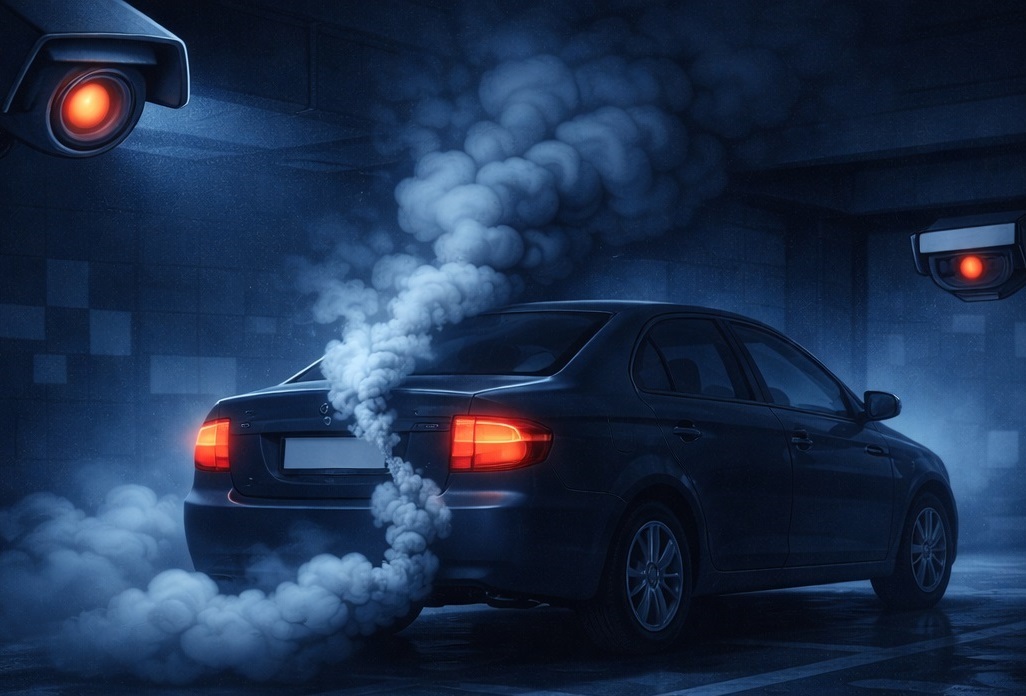
Cars with running engines in underground parking deserve special attention.
This is the kind of danger that doesn’t look dramatic, but the consequences can be serious.
From a surveillance perspective, the situation looks like this:
- the car is stationary for a long time,
- the person is either inside or has left,
- the engine is running,
- exhaust is present,
- and the system stays silent—because “nothing is happening.”
Automation solves this through a combination of factors:
- detection of a stationary vehicle,
- analysis of immobility duration,
- repeated exhaust detection,
- lack of movement.
Add license plate recognition—and you get not just an alarm, but a meaningful event that can be handled calmly and correctly.
False Alarms: Headlights, Flashes, and Operator Pain
If parking lots were fined for false alarms, half of all video surveillance systems would already be bankrupt.
Headlights are the absolute champions at destroying trust in analytics.
Second place goes to the sun.
Third—sunlight reflected in headlights, multiplied by wet concrete.
Smart systems filter out:
- short-lived light events,
- sharp but unstable illumination changes,
- flashes without scenario development.
The key principle is simple:
danger always develops—it doesn’t just appear and disappear instantly.
Why This Matters to Business, Not Just Engineers
Automating parking surveillance isn’t about fancy words like “AI” or “smart cameras.”
It’s about:
- reducing incidents,
- lowering the load on security staff,
- avoiding fines and claims,
- and—surprisingly—improving human comfort.
Systems like SmartVision are built around the idea that a camera should:
- see,
- understand,
- and act in time.
Without panic. Without hysteria. Without endless false alarms.
Parking as a Mirror of System Maturity
If a video surveillance system works well in a parking lot—it’s ready for anything.
If it doesn’t, the problem isn’t the parking lot. The parking lot is a mirror of maturity: algorithms, logic, architecture, and mindset.
And while some systems still confuse a cigarette with a fire and headlights with the end of the world, others quietly and invisibly do the most important thing of all: they prevent problems from happening.
Strangely enough, that’s exactly what good video surveillance is supposed to do.