If you believe the marketing brochures, “modern video surveillance” has existed for at least twenty years. In practice, for a long time it followed a very simple principle: the camera dutifully recorded everything, someone once a year pulled out a needed fragment, and for the remaining 364 days the archive served as an expensive digital closet. People changed, business processes became more complex, cities filled up with cars, smokers, couriers, helmets, shopping malls, and parking lots - but the cameras kept doing the same thing: watching and thinking about nothing.
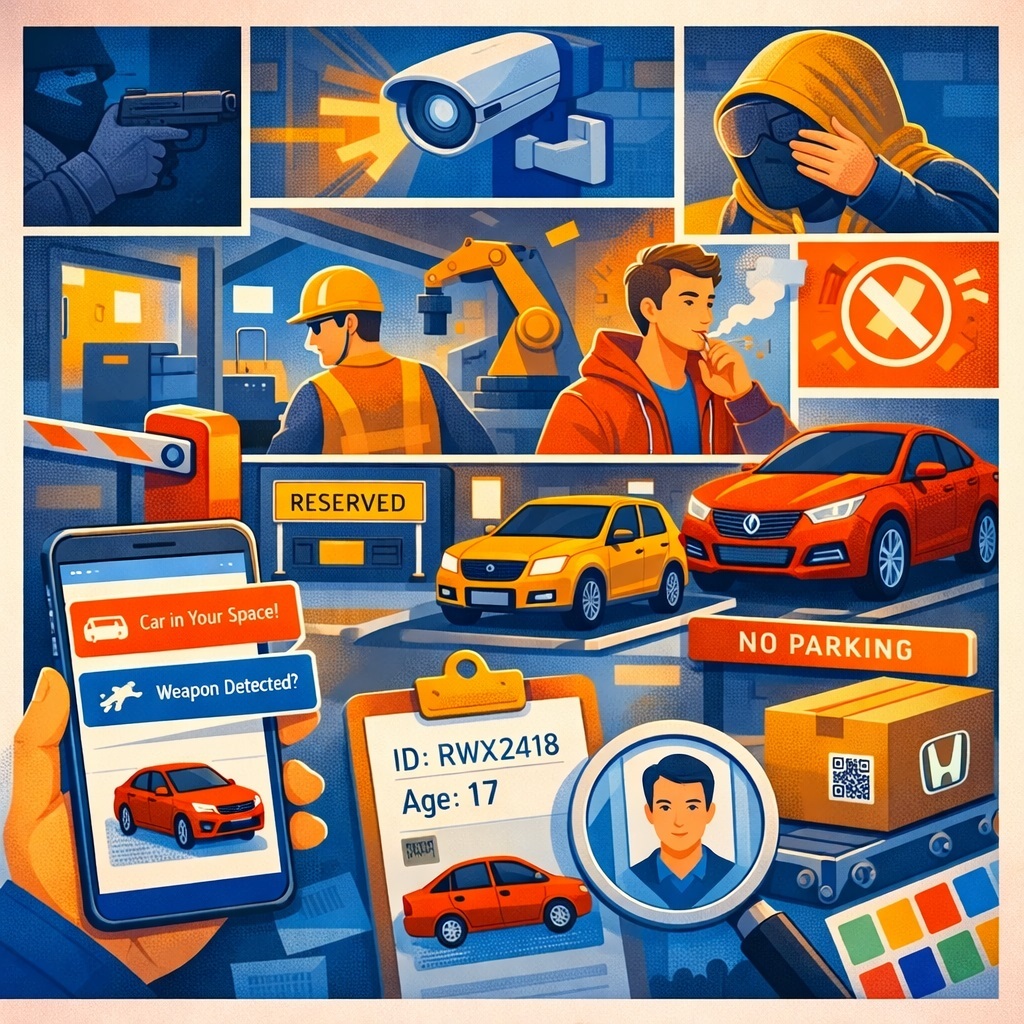
SmartVision appeared exactly at the moment when it became obvious that simply “seeing” was no longer enough. In a world where every car has a color and a brand, every visitor has an age and approximate gender, every smoker has a favorite “spot behind the pillar,” and every warehouse has hundreds of signs, QR codes, and labels, a camera without analytics is like a smartphone without the internet: technically functional, but living with it already feels strange. Ai Surveillance offers a different model. Video surveillance stops being a mute witness and becomes a participant in events. It reads text, recognizes QR codes, counts people and cars, distinguishes a helmet from a cigarette, tracks direction of movement, notices attempts to block the lens, and even knows when someone else’s crossover brazenly occupies your personal parking space.
A Camera That Can Read: OCR, QR, and a Little Magic Without Magic
Let’s start with the most “human” skill - the ability to read. Text Recognition (OCR) in SAi Surveillance is exactly the case where a camera stops being just an eye and suddenly acquires a brain that can assemble letters into words. Before OCR, the scenario was simple: an operator looks at a frame, copies a document number or a code from a label into Excel, makes a one-digit mistake, and then spends a long time explaining why the system can’t find the right pallet in the warehouse.
With OCR, it’s different. The camera looks at signs, labels, stickers, documents on a desk, a monitor screen, a paper pass in a security guard’s hand and turns all of that into text. Not “somewhere in the frame there’s a white spot with black stripes,” but something very concrete:
order number 548327,
doc 17-K,
gate No. 5,
container A-23.
Ai Surveillance allows you to search the archive by these inscriptions, link them to events, give operators hints, and collect statistics. Need a recording where a forklift placed a pallet with number “A-23” at the wrong dock? No need to remember the date and time - just type the text, and the system will show only the fragments where it appears.
At the same level lives QR Code Recognition. The world has long learned to stick QR codes on everything: passes, parking tickets, boxes, advertising posters, badges, logistics labels. But until you have a system that actually sees and understands these squares, all their advantages work only at the moment someone scans them with a smartphone. VMS makes QR codes part of video surveillance: the camera sees the code, recognizes it, and can trigger the required scenario from confirming that “this ticket really was presented at the entrance” to automatically opening a barrier or registering a visit in an accounting system.
Security no longer argues with visitors “are you sure you paid for an hour?” — because Ai Surveillance stores not only video, but also the fact of a recognized QR code with specific content. Logistics stops depending on human “I think I saw that box this morning” the system knows exactly when and where the required QR appeared in the frame and can find that moment in seconds. And if you really want, you can configure triggers: show on the alarm monitor any case of scanning an invalid code or attempting to enter with an expired ticket.
People, Flows, and That Very Line “No One Crosses”
Another fundamental shift brought by Ai Surveillance is the ability of cameras to understand human movement and turn chaotic visitor flows into structured data. The Directional Line Crossing Counter is not just “another counter,” but a meaningful filter of reality.
In classic surveillance, a person just walks back and forth. In Ai Software, they either cross a line in the correct direction or violate a scenario. At a shopping mall entrance, the line counts entries; at the exit, exits. In a “staff only” zone, it reasonably asks why people with carts are stubbornly moving against the recommended direction. In the metro, such a line flags those who try to go “backwards” through turnstiles; in a stadium, those who suddenly decide to enter a service corridor.
The key point is that the Directional Line Crossing Counter understands not just the crossing itself, but the vector. It distinguishes “from checkout to exit” from “from exit back to checkout,” “from parking to the retail area” from “from retail area to parking.” On this basis, both business analytics and security are built:
- marketing sees how many people actually reached a target zone;
- facility services see where bottlenecks form;
- security receives notifications when someone persistently moves where only staff should be.
This is complemented by Gender & Age Detection. Yes, the world is more complex than two buttons, and Ai Surveillance doesn’t engage in philosophy - it solves practical tasks. On average, the system understands whether it’s an adult or a teenager, a man or a woman. In a shopping mall, this helps assess the audience profile by zones: “this store is visited more often by women 25–35, while that one attracts young people under 25.” In sensitive areas—alcohol sections, casinos, children’s laser tag—the algorithms help notice that someone clearly under the required age has appeared in the frame and highlight this moment to the operator.
During evacuations and incident analysis, Gender & Age Detection turns into a post-event analytics tool: you can assess who moved where, where children lingered longer than adults, and which groups chose which exits. For retail, it’s material for polished presentations and layout optimization; for security services, it’s a reason to sleep a bit more confidently, knowing the camera didn’t just record everything blindly, but helped understand who exactly was in the zone at moment N.
Cars, Colors, and Personal Revenge for a Taken Parking Spot
Parking is a separate planet altogether, where people reveal their best and worst traits. Here you’ll find creative parking across two spaces, the sacred belief that “five minutes on a disabled spot is fine,” markings that are “kind of optional,” and the eternal story: someone took your paid or assigned slot.
Ai Surveillance treats parking with cold engineering tenderness. First, there is personal video surveillance for parking spaces. Each space is not just “a piece of asphalt in the frame,” but an object with logic: it has an owner or a specific visitor and rules—who and when has the right to park there. The system tracks events for each slot:
- a car parked in someone else’s space;
- marking boundaries violated (the car is too far over, parked across, blocking neighbors);
- the space is blocked—someone parked so that exit is impossible.
The parking space owner can receive notifications personally: in the app, by email, via Telegram or all at once, if vindictiveness outweighs reason. Security receives its own alerts and doesn’t have to run around floors searching for the culprit — Ai software has already seen everything, recorded it, and knows exactly which car, with which color and brand, took the wrong spot.
This is where Vehicle Type Detection and Vehicle Color & Brand Recognition come into play. For the system, a car is not just a rectangle on wheels, but an object with multiple dimensions:
- type: passenger car, truck, bus, motorcycle;
- color: from a palette of 10 basic colors (from classic white/black/gray to more expressive shades);
- brand: the vehicle make, recognized by body contours and characteristic elements.
Scenarios range from purely utilitarian to almost cinematic. Warehouse logistics can ensure that only trucks of the required type enter a specific zone, not employees’ cars. A business center management company can set rules: only vehicles with a certain status are allowed on underground level P1, while P2 is open to everyone else. For security, it’s important that the system can search:
“Find all moments in the archive over the last three days when a red car of a certain brand entered this zone.”
And yes, Ai Surveillance can search by color not only for cars. Color analytics works independently: the system analyzes the video stream and records the appearance of objects of a specified shade in a defined archive zone. A palette of 10 primary colors allows solving many practical tasks:
- find a person in a red jacket at a stadium after eyewitness reports;
- track the appearance of blue contractor uniforms in an area where they shouldn’t be;
- spot green technician vests where, by rules, only white lab coats should be.
Color filters and control zones make the operator’s life much easier: instead of scrolling through hours of footage, they work with filtered fragments where the frame actually contains someone in the required color. Combined with Brand Recognition for vehicles, this becomes a very powerful tool: “a red sedan of this brand in the VIP parking zone” is no longer a filmmaker’s dream, but a perfectly realistic search query.
Helmet, Cigarette, and the Thin Line Between “Working” and “Violating”
Manufacturing and construction have always lived on the edge between efficiency and safety. People want to work fast; management wants “no injuries and no inspectors.” Between them stand helmets, regulations, and endless safety meetings.
Safety Helmet Detection in Ai Surveillance is an attempt to add some automated common sense to this story. The system looks at people in the frame and tries to determine: if this is a zone where helmets are mandatory, is there actually something on their heads? Not a beanie, not a hood, not a branded cap but a helmet.
As soon as a person without a helmet appears in a zone marked “mandatory helmet,” Ai Surveillance can:
- highlight them on the screen;
- send a notification to the shift supervisor;
- log the incident;
- optionally even activate a local audio alert so that shame reaches the violator before the inspector does.
Add Smoking Detection to this picture, and it gets even more interesting. Smoking where it’s prohibited is one of the most persistent human sports. People find their “spots”: behind a container, on a stairwell, in a dark corner of a parking lot. SmartVision learns to recognize this visually: a characteristic posture, gesture, smoke source. No need to wait for complaints from colleagues or demands from fire inspectors—the system itself records smokers in prohibited areas.
As a result, security gets a new dimension: on the site map, you can see where people actually smoke, not just where “No Smoking” signs hang. Management receives a very concrete report: “here are the real smoking hotspots over the past month.” And when investigating incidents (for example, a fire alarm), Smoking Detection helps quickly separate “false alarms caused by smoking enthusiasts” from real threats.
When Someone Reaches for the Camera—and Someone Else for a Weapon
Video surveillance is meaningless if it can be easily blinded. Many still rely on the camera as a “witness,” forgetting that the first step of any more-or-less prepared intruder is to make sure this witness sees nothing: cover it, turn it away, defocus it, spray the lens.
Tamper Detection in Ai Surveillance is about preventing this or at least noticing it instantly. The system tracks:
- defocus — when the image suddenly turns into a soapy watercolor;
- field-of-view changes — the camera suddenly looks somewhere else;
- direct lens obstruction by something opaque.
Each such event is treated not as “well, it happens,” but as potential sabotage. Ai Software immediately raises an alarm: a Telegram notification, a signal on the alarm monitor, event logging, map linkage. This allows real-time response: send someone to check the camera, activate a neighboring PTZ view, see who exactly decided to “adjust” the device.
Weapon Detection lives nearby but solves a much more dramatic task. The system analyzes silhouettes in the frame and tries to determine whether someone is holding an object resembling a weapon. This is not Hollywood magic where pixel-level models are identified, but a practical scenario: if a person appears in the frame with a long object resembling a rifle or a characteristic “pistol-like” silhouette, the system flags this as a high-priority event.
In shopping malls, at mass events, in bank branches, at large enterprise checkpoints, this becomes another layer of protection. The operator doesn’t need to “accidentally notice” a strange silhouette in the lower-right corner of one of thirty cameras - ai software highlights the frame, displays it on the alarm monitor, and gives a chance to react before the situation makes the news.
When Tamper Detection and Weapon Detection work together, the picture becomes complete: the system sees both attempts to blind cameras and potentially dangerous objects in the frame. Combined with the Directional Line Crossing Counter, this allows, for example, tracking a person with a weapon moving toward a specific zone, not just appearing randomly in view.
Integrating All the “Smart Stuff”: From QR to Helmet
The strength of ai softwareis not that somewhere in the settings there are a dozen nice checkboxes—“recognize text,” “see helmets,” “search by color.” The real magic begins when these functions start working together.
A typical scenario might look like this. At the entrance to a closed parking area, the camera recognizes a QR code on a ticket, confirming that the car is entering with a valid reservation. At the same time, the system determines the vehicle type, its color and brand, and links all this to a specific parking space assigned to a resident.
On the way from parking to the office, cameras with Gender & Age Detection and Directional Line Crossing Counter count visitors, assess flows, and help understand who uses entrance groups and how. In the warehouse, OCR reads text from labels, recording which pallets went where and which docks were used. QR codes confirm that this specific shipment passed the required control.
In the production shop and on the construction site, Safety Helmet Detection ensures that people in mandatory zones wear helmets, while Smoking Detection catches those who decided to smoke near flammable materials. Across the entire site, Tamper Detection monitors that cameras don’t “accidentally” look at the floor or get neatly covered with chewing gum.
If a person with an object resembling a weapon appears on the premises, Weapon Detection notices it and triggers a chain of reactions from displaying the camera on the alarm monitor to sending a POST request to an external security system. If there’s a need to find a specific car by color and brand, Vehicle Color & Brand Recognition does it without hours of archive scrolling.
And if three weeks later a lawyer comes with the question, “who and when placed this box with number X in this corridor?”. OCR will find all moments when that text appeared in the frame, Directional Line Crossing will show where it was moved from and to, and object color analytics will help filter out irrelevant events where the number merely flashed in the background.
Video Surveillance That Finally Does Its Job
The funniest thing about ai software is that all this “smartness” ultimately brings video surveillance back to its original purpose. Systems were installed not so that a year after an incident someone could find a disk and discover that the needed fragment “somehow wasn’t recorded.” They were installed so that at the moment of an event, a decision could be made: stop, prevent, record, prove.
Text Recognition and QR Code Recognition teach cameras to understand context—not just “a box in the frame,” but “a specific box with a specific number.” Directional Line Crossing Counter and Gender & Age Detection turn crowds into data flows you can work with. Vehicle Type / Color & Brand Recognition and personal parking space surveillance add a layer of civilized vengeance: now you can not only be angry at the person who took your spot, but also get video, make, color, and time, backed by analytics.
Smoking Detection and Safety Helmet Detection move the eternal struggle for rule compliance from “well, we told everyone” into real control. Tamper Detection and Weapon Detection handle extreme cases—when someone tries to blind the system or arrives with something they really shouldn’t. Searching by object color in the archive turns massive video datasets into a manageable tool: “show me everyone in orange vests in this zone yesterday.”
At some point it becomes obvious: SmartVision is not just a “smart camera,” not a magic module, and not a single detector. It’s an attempt to do what video surveillance was expected to do for many years, but people hesitated to articulate: not to get in the way of life, not to turn the operator into a living archive player, and not to force everyone to hope for a miracle at the very moment when something actually happens.
The world won’t become safer just because cameras are hanging from the ceiling. But it certainly becomes a bit more manageable when those cameras can read text and QR codes, count people, distinguish vehicle types and colors, notice helmets and cigarettes, detect weapons and attempts to block the lens, remember who exactly took your parking space - and do all this quietly, systematically, and with a light touch of irony. SmartVision is exactly that kind of system: it doesn’t promise to stop evil everywhere, but very politely suggests starting at least with your parking lot, your warehouse, and your business center - where a good brain attached to a camera has long ceased to be a luxury and become a necessity.