
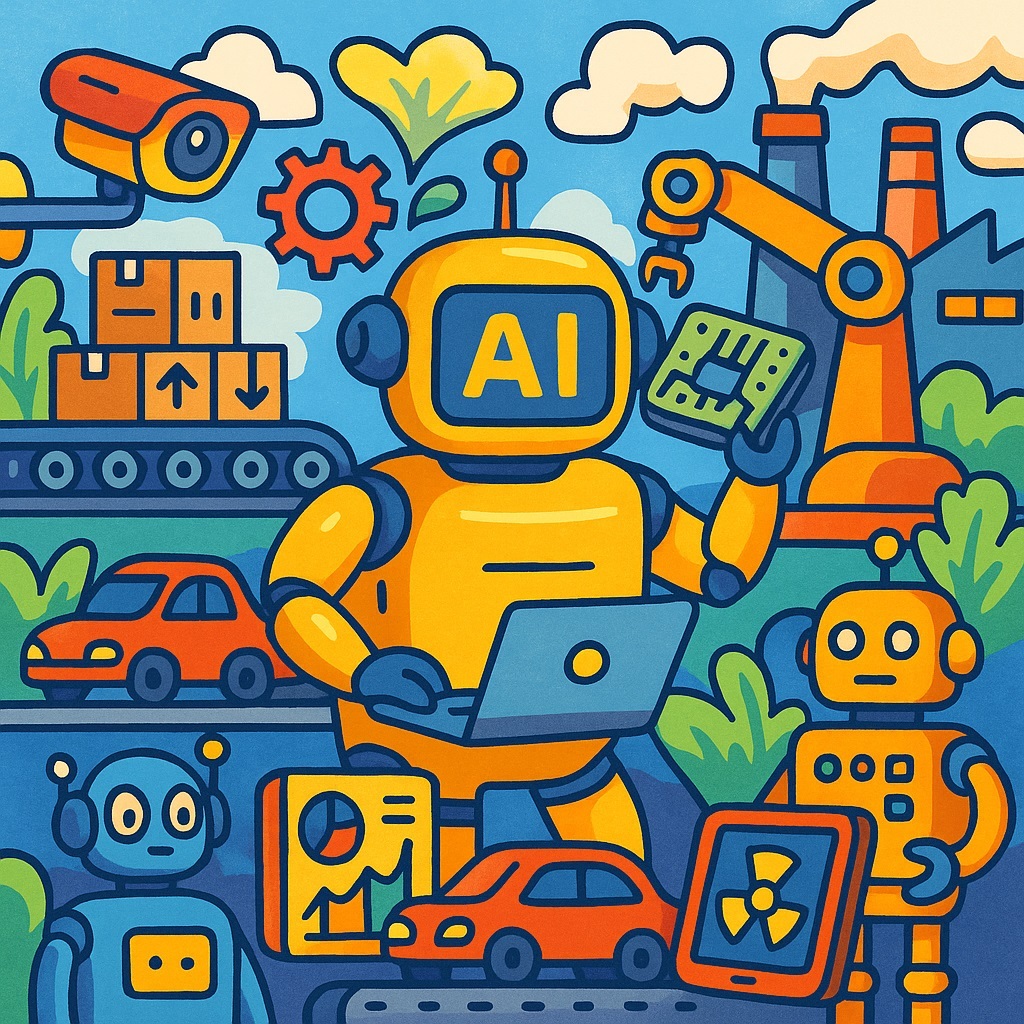
Modern industry is undergoing the deepest transformation since the first assembly line.
If the 20th century was about horsepower, pressure, and throughput, the 21st is about data. Every valve, motor, conveyor, and camera has become a source of information. Sensors, controllers, and vision systems now not only operate machines — they describe them.
In this new ecosystem, artificial intelligence (AI) is not a magic black box; it’s a new way of thinking about production. It turns measurements into insight, signals into forecasts, and operational logs into action.
If the first wave of digitalization automated routine tasks, the current wave is about self-analysis — industries that observe, understand, and improve themselves.
But between “we installed cameras” and “we run predictive analytics,” there’s a long, winding road. Most plants share the same pain points: lack of reliable data, isolated systems, minimal integration, outdated maintenance routines, and an absence of analytic culture.
This paper outlines where AI truly works, how to implement it without massive budgets, and which steps should come first to deliver maximum impact at minimum cost.
Data First: No Intelligence Without Observation
The single biggest weakness across industries is the absence of reliable, structured data.
A factory may have thousands of sensors and dozens of controllers, yet still rely on manual entries like “operating normally” and “no issues reported.”
No algorithm can optimize what it can’t observe. Machine learning doesn’t guess; it learns.
Before deploying any AI, an organization must first learn to see itself — to capture, label, and preserve its own behavior in data form.
That means three concrete steps:
- Deploy sensors and cameras to create a foundation for observation.
- Record and store telemetry continuously, not just when there’s a failure.
- Standardize data collection across systems so events are correlated, not scattered.
Technically, this is inexpensive. Culturally, it’s challenging.
Without consistent data streams, any “intelligent” solution is a hollow shell — impressive in a demo, useless in real life.
Machine Vision: Eyes That Don’t Blink or Argue
Industrial video surveillance is decades old. What’s new is that the camera has learned to think.
Computer vision systems now recognize what is happening, not just that something is visible.
In a steel plant, AI detects open flames and workers without helmets.
In automotive assembly, it tracks torque sequences and verifies proper alignment.
In food production, it checks for sanitation compliance and contamination risks.
In logistics, it monitors forklift activity and loading efficiency.
The magic is not in new hardware — most facilities already have cameras.
The upgrade comes from adding an analytical layer: software that interprets video as data.
Each frame becomes a measurement. AI classifies events, counts occurrences, and identifies deviations: a stopped conveyor, an idle station, missing gloves, or a hint of smoke.
For managers, this means objective visibility.
Data that used to depend on subjective human reports now flows automatically and continuously.
Quality Control: From Sampling to Continuous Assurance
Traditional quality inspection works by sampling — testing a few units and extrapolating results.
AI makes that obsolete. Computer vision and pattern recognition now allow 100% inspection of every unit, every shift.
Neural networks detect microcracks, misalignments, uneven coatings, or label offsets in milliseconds.
For pharmaceuticals, cosmetics, and food, this is already the norm. For manufacturing and textile industries, it’s rapidly becoming one.
The advantages are immediate:
- No more human fatigue or oversight.
- Dramatic reduction in defect rates and recalls.
- Complete traceability for every batch and product.
Technically, the setup is simple: camera, lighting, and a trained model.
The return is enormous — a zero-defect process that runs at full line speed.
Predictive Maintenance: From Calendar to Condition
Preventive maintenance — the old “service every six months” rule — is both expensive and inefficient.
Parts are replaced too early, or worse, they fail between inspections.
Predictive maintenance turns that guesswork into science.
By monitoring vibration, current draw, temperature, and pressure, AI models detect patterns that precede failure.
A bearing doesn’t just “break.” It sings — with frequencies a human can’t hear.
An algorithm listening to that data can warn, “Motor #3 will likely seize within 72 hours.”
This shift from scheduled to condition-based maintenance changes everything:
Fewer breakdowns, fewer unplanned stops, more uptime.
And it doesn’t require a full digital overhaul — just a few smart sensors and a laptop capable of running models locally.
Energy Management: When Intelligence Meets Inertia
The second-largest source of industrial losses is not downtime or defects — it’s wasted energy.
Equipment runs idle, air compressors hum through the night, ventilation systems never sleep.
AI tracks energy profiles, finds patterns, and identifies waste.
It can reschedule power-hungry tasks, adjust HVAC loads, or throttle pumps during low demand.
Many facilities see 15–30% energy savings without replacing a single machine.
A simple model trained on monthly consumption data might reveal that chillers operate at full load during empty shifts — an easy fix with major savings.
This isn’t the “smart home” cliché — it’s industrial optimization with measurable ROI.
Safety: From Recording to Anticipating
Safety systems often work in hindsight — an alarm rings after the danger has already arrived.
AI brings foresight. Computer vision monitors workers’ posture, gear, and movement. It knows if someone enters a restricted zone or if a worker collapses from heat stress. It recognizes smoke or flames and differentiates them from harmless reflections or welding arcs. In refineries and chemical plants, this prevents fatalities. In construction and fabrication, it prevents injuries.
For small shops, it replaces a full-time safety inspector. The idea is simple but powerful: situational awareness at machine speed.
Small Manufacturers: Smart Without the Capital
Not every factory is a mega-plant. Small and mid-sized manufacturers often have tight budgets and lean teams — but they also have the most to gain. Two cameras, one vibration sensor, and a desktop PC can already form a local “smart cell.”
AI models can count production cycles, identify idle time, and detect quality deviations in real time. Instead of complex ERP systems, small firms get visual dashboards: where time is lost, where energy is wasted, where improvement is possible.
This is not “pretend digitalization” — it’s engineering minimalism done right. The smartest factories are often the smallest ones, because they can adapt fast and measure everything.
Integration: From Data Islands to Unified Architecture
Even tech-savvy plants suffer from fragmentation. ideo lives on one server, SCADA on another, maintenance logs in spreadsheets. Each subsystem is competent on its own but blind to the others.
True AI impact comes when these layers are unified — when vision, telemetry, and planning data feed into a common analytic core. Example: a camera detects a stalled conveyor → the MES system adjusts production timing → ERP recalculates delivery deadlines. hat’s a closed feedback loop.
At higher maturity, these systems form a digital twin — a living virtual replica of the plant, synchronized with real-time data. It’s not science fiction, but it only works after the basics — consistent data and integration — are in place.
Implementation: From Quick Wins to Strategic Growth
AI adoption must be evolutionary, not revolutionary.
Trying to “go smart” overnight usually ends in confusion and budget overruns.
A sound roadmap looks like this:
- Stage 1: Observation. Install cameras, collect data, standardize storage.
- Stage 2: Local Intelligence. Apply video analytics, energy monitoring, simple predictive models.
- Stage 3: Cross-System Analytics. Connect AI to MES, ERP, and maintenance systems.
- Stage 4: Digital Twin and Optimization. Model the entire process and let AI adjust it autonomously.
Each stage builds on the last. The path may take years, but the returns compound with every step.
Real-World Cases and Engineering Pain Points
Metallurgy: Overheated crane bearings caused weekly stoppages.
Solution: vibration sensors + predictive algorithm.
Result: 70% fewer breakdowns; ROI in three months.
Food Processing: Workers skipped gloves and masks.
Solution: computer vision for PPE detection.
Result: 100% compliance, zero manual inspections.
Warehousing: Pallets went missing.
Solution: AI-based license plate and cargo tracking.
Result: full traceability, faster dispatch.
Agriculture: Uneven irrigation caused yield loss.
Solution: drone imaging + AI crop analysis.
Result: 15% yield increase and lower water use.
Solution: vibration sensors + predictive algorithm.
Result: 70% fewer breakdowns; ROI in three months.
Food Processing: Workers skipped gloves and masks.
Solution: computer vision for PPE detection.
Result: 100% compliance, zero manual inspections.
Warehousing: Pallets went missing.
Solution: AI-based license plate and cargo tracking.
Result: full traceability, faster dispatch.
Agriculture: Uneven irrigation caused yield loss.
Solution: drone imaging + AI crop analysis.
Result: 15% yield increase and lower water use.
Each case shares one principle: measure, then predict.
AI doesn’t replace engineering logic; it enhances it.
Top Priorities for Immediate ROI
- Data Collection & Visibility — build the foundation.
- Video Analytics — use existing cameras for insight.
- Predictive Maintenance — stop repairing the obvious, start predicting the hidden.
- Quality Control — transition to full inspection.
- Energy Analytics — cut waste fast.
- Safety Monitoring — protect people and reputation.
Each can start small and expand later — modular, low-risk, and fast to implement.
What Can Wait
Not every shiny technology needs to be first.
- Advanced logistics optimization and scheduling algorithms require mature data.
- Full-scale digital twins only make sense after integration is stable.
- Fully autonomous decision-making must follow, not precede, human trust.
Patience is part of engineering discipline.
Rushing digital transformation often produces more dashboards than results.
Human Factors: Culture Before Code
The toughest barrier is not technical — it’s psychological.
Engineers worry AI will replace them. Supervisors fear cameras will turn into surveillance. Executives fear endless pilot projects.
The antidote is transparency.
AI must be presented not as a monitor, but as an assistant.
It doesn’t judge; it warns. It doesn’t replace; it augments.
When people see that automation reduces errors, fatigue, and accidents — resistance turns into ownership.
A healthy data culture is the real foundation of any intelligent factory.
Economics of Industrial AI
Across industries, the numbers converge:
- 70% reduction in failures and safety incidents.
- 20–40% increase in overall equipment effectiveness (OEE).
- 15–25% energy savings.
- 30–50% reduction in scrap and rework.
- ROI: typically within 3–12 months for baseline projects.
These aren’t marketing slides — they come from modest, well-targeted implementations using existing infrastructure.
The rule of thumb: the first 20% of effort delivers 80% of value.
The Next Horizon: Self-Organizing Industry
The end goal isn’t a “fully automated factory.”
It’s a self-optimizing ecosystem, where every sensor, camera, and machine contributes to collective awareness.
Machines will exchange data directly, predict their own maintenance, and coordinate with logistics and power systems.
Human engineers will supervise, analyze, and innovate — not chase alarms.
The transition starts not with robots or neural networks, but with the discipline to listen to one’s own data.
Artificial intelligence is not a luxury — it’s the modern instrument of industrial self-awareness.
It helps plants see what was invisible and predict what used to be random.
The smartest strategy is to begin small:
collect data, enable video analytics, monitor energy and vibrations.
Each step increases visibility, stability, and maturity.
Eventually, a factory realizes it’s no longer “adopting AI” — it operates like AI: observing, learning, predicting, and improving.
That is not hype. That is engineering evolution — steady, methodical, and inevitable.